
As an Amazon Associate I earn from qualifying purchases.
The layer against your skin decides how the rest of your clothes work. Sweat through a cotton T-shirt on the walk in and you will shiver on stand no matter how good your jacket is. The best merino base layer for hunting moves that sweat off your skin, stays warm when it is damp, and does not turn rank after three days in camp.
This list is for deer hunters heading into the rut, gun season and late season. We compared merino tops by fabric weight, fit and the details that matter under a pack or a safety harness, and we picked one budget set that includes bottoms.
| Product | Best for | Our rating | |
|---|---|---|---|
 Sitka Core Merino 330 Half-Zip | Best for late season330 g/m² merino face (maker spec) with a half-zip for venting | ★★★★½ 4.5/5 | Check price |
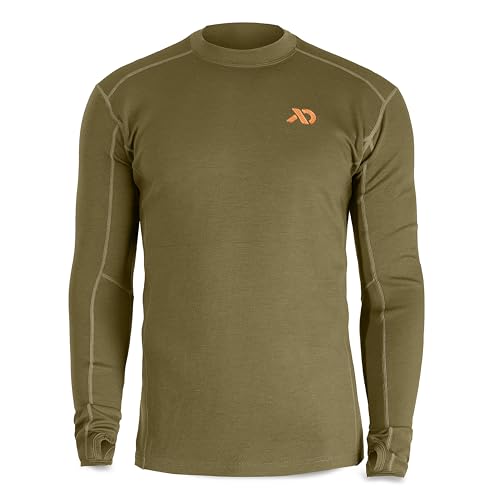 First Lite Kiln Long Sleeve Crew | Best all-around midweight250 g/m² Merino-X with raglan sleeves for pack straps | ★★★★½ 4.5/5 | Check price |
 Smartwool Classic Thermal Merino Crew | Best everyday warmthInterlock thermal knit with offset seams in a slim fit | ★★★★½ 4.5/5 | Check price |
 Minus33 Midweight Crew | Best pure merino100% merino at 235 g/m² (maker spec), sizes to 6XL | ★★★★☆ 4/5 | Check price |
 Icebreaker 260 Tech Long Sleeve Crew | Best for the hike inUnderarm gusset and offset seams for long walks in | ★★★★☆ 4/5 | Check price |
 Merino.tech Midweight Set | Best budget setTop, long johns and merino socks in one box | ★★★★☆ 4/5 | Check price |
How we picked the best merino base layer for hunting
We read each maker’s specs and compared what matters on a hunt, not on a ski hill. We did not wear-test every top for a full season, so the fabric weights below are maker specs, listed in grams per square meter (g/m²).
The star ratings are our own editorial scores for how well each pick fits this job: keeping a deer hunter dry on the walk in and warm through a long, cold sit.
1. Sitka Core Merino 330 Half-Zip: best for late-season sits
Sitka Core Merino 330 Half-Zip
Sitka's warmest merino top for frigid dark-to-dark sits
A 330-gram, 17.5-micron merino exterior (maker spec) over a soft synthetic interior, with a half-zip for venting and Optifade camo.
The Sitka Core Merino 330 Half-Zip is the warmest top on this list. Sitka lists a 330-gram, 17.5-micron merino exterior over a recycled synthetic interior, and says the synthetic face is there for anti-itch comfort and better moisture handling. It comes in Optifade camo, so it can stand alone on a mild early-season walk.
The half-zip lets you dump heat on the walk in, then zip up once you settle. Sitka says it can go in the washer and dryer with your regular laundry, and the sleeves have snag-resistant stitching for pack straps. The drawback: it is a blend, not pure merino, and it is a lot of top for a 50-degree October afternoon.
For a hunter who sits from dark to dark in December, this is the top to start with.
2. First Lite Kiln Long Sleeve Crew: best all-around midweight
First Lite Kiln Long Sleeve Crew
A midweight merino crew built around a hunter's pack
250-gram Merino-X interlock fabric (maker spec) with raglan sleeves, flatlock seams and First Lite camo, warm enough for cold mornings.
The First Lite Kiln Long Sleeve Crew is built from First Lite’s 250-gram Merino-X fabric in an interlock knit. First Lite pitches it as a first or second layer from cold mountain mornings to late-season tree stand sits, and at 250 g/m² it lands in the midweight sweet spot.
The details are hunter-specific: modified raglan sleeves so nothing binds under a loaded pack, flatlock seams to cut chafing, and First Lite camo patterns. The drawback: a midweight crew alone will not carry you through a single-digit sit, so plan on a heavier layer over it in deep cold.
3. Smartwool Classic Thermal Merino Crew: best for everyday warmth
Smartwool Classic Thermal Merino Crew
A slim thermal merino crew that layers cleanly under camo
Smartwool's interlock thermal knit with a body-skimming fit and offset flatlock seams that stay out from under pack straps and harness webbing.
The Smartwool Classic Thermal Merino Crew is the base layer a lot of hunters already own from skiing or shoveling snow, and it earns its spot on stand too. Smartwool uses an interlock knit in its warmer thermal weight, with a slim, body-skimming fit that layers cleanly under a hunting jacket.
Offset shoulder and side seams that wrap to the front keep seams away from pack straps and harness webbing. The drawback: it comes in solid colors, not camo, so it lives under your outer layers rather than on its own.
4. Minus33 Midweight Crew: best pure merino
Minus33 Midweight Crew
No-blend 100% merino crew in sizes most brands skip
18.5-micron merino at 235 g/m² (maker spec) in an interlock knit with flatlock seams, sized from XS to 6XL plus talls.
The Minus33 Midweight Crew is 100% merino with no synthetic core. Minus33 lists 18.5-micron merino at 235 g/m² in an interlock knit with flatlock seams, and a garment weight of 11.2 ounces in a size large. It comes in sizes from XS to 6XL, plus tall sizes, which few brands match.
This New England company has made merino base layers since 2004, and this crew is a no-nonsense workhorse for three seasons of hunting. The drawback: pure merino is less durable than a blend where pack straps rub, and the slightly coarser fiber can feel scratchier to sensitive skin than the 17.5-micron tops.
5. Icebreaker 260 Tech Long Sleeve Crew: best for the hike in
Icebreaker 260 Tech Long Sleeve Crew
A heavier merino crew that moves with you on long walks
Icebreaker's 260 Tech crew with an underarm gusset, forward side seams and offset shoulders that keep pack straps off the seams.
The Icebreaker 260 Tech Long Sleeve Crew is Icebreaker’s heavier merino base layer, built with an underarm gusset and forward side seams for freedom of movement. That makes it a good fit for hunters who walk a long way to a public-land stand or hang a saddle in the dark.
Offset shoulder seams prevent pack rub, and flatlock seams cut chafing. The drawback is the same as the Smartwool: solid colors only, so it stays under your camo.
If your hunts start with a mile or more of walking, this is the one to pick.
6. Merino.tech Midweight Set: best budget top and bottom
Merino.tech Midweight Set
A full merino top and bottom set, socks included
Soft 17.5-micron, 100% merino top and long johns in a midweight, with a pair of merino hiking socks in the box.
The Merino.tech Midweight Set gets you a top, long johns and a pair of merino hiking socks in one box. Merino.tech lists 100% superfine 17.5-micron merino, and the set comes in lightweight, midweight and heavyweight versions so you can match it to your season.
For a hunter who has never owned merino, this is the easy way to try a full system. There is a women’s version too, the Merino.tech women's midweight set. The drawback: Merino.tech recommends hand washing and laying it flat to dry, which is a chore at deer camp.

Buying guide: choosing a merino base layer for hunting
Any of these six will beat cotton. The right pick depends on when you hunt, how far you walk, and how much time you spend sitting still in the cold.
Why merino beats cotton next to your skin
Nebraska Extension puts it plainly: cotton, once wet, has little or no insulating value, and the same guide notes that wool is the traditional choice for a layer that still insulates when it gets damp from sweat, rain or snow. For a deer hunter who sweats on the walk in and then sits still for hours, that is the whole game.
Match fabric weight to your season
- Lightweight (about 150 to 200 g/m²): early bow season and warm afternoons, or as a thin first layer under a midweight.
- Midweight (about 200 to 260 g/m²): the rut and most of gun season. The First Lite Kiln, Minus33 and Merino.tech picks live here.
- Heavyweight (about 260 g/m² and up): late season and all-day sits in deep cold, like the 330 g/m² Sitka half-zip.
These ranges are rough guides, since each maker draws the lines a little differently. Check the maker’s listed g/m² rather than the word on the tag.
Build the rest of the system around it
A base layer is only the first piece. Our cold-weather layering system covers the mid and outer layers, and our guide to what to wear under rain gear covers wet days. For your hands, see our best hand warmers for hunting.
Frequently asked questions
What weight merino base layer is best for deer hunting?
For most of the rut and gun season, a midweight around 230 to 250 g/m² is the most useful, like the First Lite Kiln Long Sleeve Crew or the Minus33 Midweight Crew. For late-season sits in deep cold, step up to a heavyweight such as the 330 g/m² Sitka Core Merino 330 Half-Zip.
Does merino wool really help with scent control?
Merino resists odor buildup better than most synthetics, which helps on multi-day hunts. It does not make you scent-free. Wash base layers in a scent-free detergent, store them sealed, and still hunt the wind.
Can you put merino base layers in the dryer?
Some, yes. Sitka says its Core Merino 330 Half-Zip can be washed and dried with regular laundry. Merino.tech recommends hand washing its sets and laying them flat to dry. Check the care tag, since pure merino can shrink with high heat.
Is merino itchy?
Modern merino is much finer than an old wool sweater. Tops made from 17.5-micron fiber, like the Merino.tech Midweight Set, are the softest here. The Sitka half-zip adds a synthetic inner face for anti-itch comfort if your skin is sensitive.