
The best climbing sticks for big feet have two features working together: enough step surface to support a bulky hunting boot and enough clearance to place that boot without scraping the tree. Width alone can be misleading. A broad step that sits close to the trunk may feel more cramped than a moderately sized step with a deeper standoff. For most hunters wearing insulated, wide, or high-volume boots, the XOP-XTREME OUTDOOR PRODUCTS option ranked first because it combines a spacious slip-resistant step with unusually useful boot-to-tree clearance.
Fit still depends on your boots, climbing technique, tree choice, and attachment setup. Treat this guide as a way to narrow the field, then perform a controlled ground-level fit check before hunting. A climbing stick should let you place the solid part of your sole securely, transfer weight without rolling your ankle, and descend without searching blindly for a foothold.
What Bigger Boots Need From a Climbing Stick
Hunters with large feet often focus first on step width, but usable footing is a three-dimensional question. The step must provide lateral room, project far enough from the trunk, and retain traction when the sole carries mud, frost, leaf fragments, or soft bark. The shape of the step ends also matters because raised edges can help a boot locate the boundary of the standing area, while aggressive projections can become uncomfortable if the sole is unusually flexible.
Tree clearance is especially important with insulated boots. Thick toe caps, broad forefeet, and substantial heel lugs occupy more space than the size number on a boot box suggests. If the stick holds the foot too close to the bark, the hunter may turn the boot outward, stand on the arch, or climb with only the edge of the sole supported. Those compensations reduce balance and become harder to manage during a dark descent.
Also consider whether the stick offers a double step, a platform-like surface, or alternating foot positions. Double-sided footing can make it easier to pause with both feet near the same level, but only if the tree, stick, and instructions permit the intended stance. A larger surface is helpful when it remains rigid and properly attached; it does not compensate for a loose strap or poorly seated bracket.
Boot-fit shortcut: Evaluate the full hunting boot, not your casual shoe size. Insulation, gaiters, toe shape, and tread overhang determine how much step and trunk clearance you actually need.
How These Climbing Sticks Were Ranked
The ranking prioritizes usable boot space rather than treating overall stick length or low carry weight as a substitute for comfortable footing. The first consideration is the relationship between step width and tree clearance. Next come traction geometry, attachment security, standing position, and the ease of packing a complete set for mobile hunting. Portability matters, but it follows safe, repeatable foot placement.
The leading choices solve the large-boot problem in different ways. Some provide a broad conventional step, one provides a more platform-like standing surface, and another folds its steps away from the trunk to create room where bulky footwear commonly binds. The lower-ranked options are not incomplete accessories; each is a complete climbing-stick set with its own attachment hardware. The order reflects broad usefulness for larger boots, not a claim that one configuration fits every hunter or tree.
Material limitations are part of the ranking. A wider surface can add pack bulk. Longer sticks can be awkward in dense cover. Rope, webbing, and buckle systems have different learning curves. The right choice is the one you can attach consistently, climb without improvised movements, and inspect thoroughly before every use.

XOP X2 Midnight Climbing Sticks
This is the strongest all-around choice for bulky hunting boots because it combines a spacious step with deep tree-side clearance.

EZshoot LXB-02 Climbing Sticks
The spacious standing platform makes this a strong choice for hunters who want more freedom to center a broad boot.

CVLIFE ZMX-HW-00412 Climbing Sticks
This set offers useful extra standing room and traction-oriented step geometry for hunters wearing broad, wet-weather boots.

Tethrd Skeletor Climbing Sticks
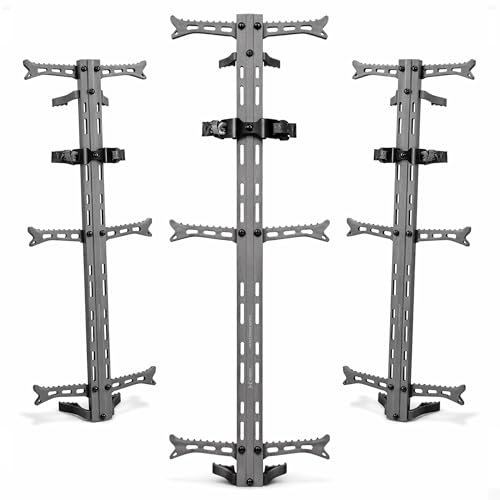
The folding dual steps deploy away from the tree, making this set well suited to bulky boots that tend to crowd the trunk.
Hawk Helium Climbing Sticks
These longer sticks pair broad dual-sided footing with a nesting design for hunters who favor a more traditional ascent layout.
Wide Steps and Deep Standoffs Solve Different Problems
A wide step gives the boot more room from side to side. That can reduce the feeling that the outer edge of the sole is hanging in space, especially when pausing to move a tether or position the next stick. Width also creates more freedom to shift the foot slightly when climbing around a leaning or irregular trunk. It is most valuable when the entire usable surface has dependable traction.
A deep standoff addresses the space between the step and the bark. This is where bulky boots often struggle. If the gap is shallow, the toe may contact the tree before the middle of the sole reaches a stable position. The hunter then has to angle the foot, which can twist the knee and place pressure on a smaller portion of the tread. More clearance allows a straighter foot position and can make descending easier because the heel and toe have room to pass the trunk.
Neither measurement should be judged alone. A step can look generous while offering little practical room once it is mounted against rough bark. Conversely, a step with strong clearance may still feel narrow to a hunter who wants to place both boots near the same elevation. Examine the assembled geometry and imagine the actual path your boot follows as you step up, transfer weight, and lift the trailing foot.
Field rule: Favor the configuration that supports a square, deliberate foot placement. If the design forces you to balance on the arch, hook a heel behind the step, or rotate your knee to clear the trunk, it is a poor match for your footwear.

Match the Step Style to Your Climbing Technique
Conventional double steps are familiar and provide clear left-right placement. They work well for hunters who climb methodically and value the ability to establish a stable foot before moving a hand or tether. For large boots, pay attention to whether both sides remain usable once the stick is seated against the tree. Branches, trunk flare, and leaning bark can reduce effective room on one side.
A broad platform-style step provides more freedom to center the boot or make a small correction after weighting it. That can be reassuring for hunters whose stiff soles provide limited feedback. The tradeoff is pack shape: a wider structure may occupy more space or catch vegetation unless the set stacks cleanly. Confirm how the assembled sticks ride on your stand, saddle pack, or backpack rather than judging one loose stick.
Folding steps can reduce transport bulk and help prevent protrusions from snagging during the walk. A design that deploys away from the trunk can also provide useful toe room. Folding components introduce an additional setup check, however. Each step must be fully deployed, unobstructed, and ready to accept weight before the climb begins. Do not assume a step moved into position simply because the stick was unpacked.
Longer sticks may reduce the number of separate attachment points needed for a chosen climbing pattern, but they can be less convenient in brush, on crooked trunks, or when attached to a compact mobile setup. Shorter sticks can pack more neatly and allow flexible spacing, yet they may require more individual placements. Use the manufacturer’s prescribed spacing and attachment procedure rather than stretching gaps to reach an arbitrary hunting height.
Attachment Security Matters More Than Step Size
A roomy step is only useful when the stick remains firmly seated. Climbing-stick attachment systems commonly use straps, webbing, rope, buckles, buttons, tabs, or a combination of those elements. Each system must be routed exactly as its manufacturer specifies. Substituting a knot, reversing a buckle path, or wrapping around an obstruction can change how the load reaches the bracket and tree.
Before leaving the ground, align the stick so its tree-contact points engage solid bark. Keep straps and ropes away from broken limbs, loose bark plates, sharp edges, and places where they could slide toward a narrower section of trunk. Apply controlled downward pressure to settle the attachment, then check for rotation and side-to-side movement. Repeat the check after loading the lowest step while remaining close enough to step safely back onto the ground.
Tree shape changes attachment behavior. A straight trunk with sound bark provides a different interface from a deeply furrowed, tapered, leaning, wet, or smooth-barked tree. A bracket that contacts only a high ridge may feel tight initially but shift when weighted from the side. If the stick cannot seat predictably, choose another tree. Do not fill a gap with loose material or improvise an unsupported spacer.
Safety warning: A climbing stick is part of a fall-risk system, not a freestanding ladder. Use a properly fitted full-body fall-arrest system or hunting saddle and remain connected according to the equipment manufacturers’ instructions. Inspect every component before use, observe all stated limits, and never climb a damaged, dead, icy, or unsuitable tree.
How to Check Fit With Your Hunting Boots
Conduct the first evaluation in daylight on a suitable tree with the lowest usable setup. Wear the exact boots, socks, gaiters, and outer layers you expect to use. Clothing bulk can change how easily you lift a knee and move around the trunk, while a stiff cold-weather sole can make a step feel different from the same boot in warm conditions.
- Check toe clearance: Place the boot normally rather than forcing it sideways. The toe should reach a stable position without jamming against the bark.
- Check sole engagement: Confirm that a substantial, load-bearing part of the tread rests on the step and that the arch is not bridging an uncomfortable projection.
- Check lateral room: Shift only enough to simulate normal balance corrections. The boot should not roll easily over an edge.
- Check traction: Use clean soles first, then consider how the tread pattern will interact with the step when field debris is present. Never intentionally contaminate the step for a test.
- Check the ascent path: Raise the trailing boot and confirm that the toe, heel, and gaiter can pass the trunk and attachment hardware without catching.
- Check the descent path: Look down and place the boot deliberately. Determine whether the step can be found and loaded without twisting the leg.
- Check for movement: Stop immediately if the stick rotates, settles unexpectedly, or separates from the bark.
- Check packed compatibility: Stack the complete set with the gear you carry and verify that steps, ropes, and straps remain controlled during transport.
Repeat the ground-level exercise with both feet leading. Many hunters have a dominant side and unconsciously tolerate worse placement with the other leg. A sound setup should not require a precise athletic move every time. If one boot repeatedly lands on an edge, the problem is likely the geometry, spacing, or mounting position rather than something to “get used to” at height.
Traction, Mud, and Cold-Weather Handling
Step traction comes from the interaction between metal texture and boot tread. Deep, open tread may engage pronounced grooves well, while a flatter sole may depend more on broad surface contact. Mud can pack both patterns and reduce friction. Before climbing, clear debris from your soles with a safe ground-level method and inspect the steps for contamination. Do not strike or scrape a load-bearing component in a way that could damage its finish or shape.
Frost and freezing moisture deserve a conservative response. A serrated or coated step is not a guarantee against slipping. If ice prevents reliable contact at the bracket, attachment, or standing surface, postpone the climb or use a safer ground-based setup. Descending after temperatures change can be more difficult than ascending, so evaluate the conditions expected for the entire sit rather than only at setup time.
Gloves also affect handling. Practice opening steps, separating stacked sticks, and operating the attachment method at ground level while wearing your hunting gloves. A system that is simple with bare hands may demand more attention when dexterity is reduced. Keep loose attachment material controlled so it cannot tangle around steps, vegetation, or your tether.
Fast takeaway: For bigger boots, prioritize stable sole contact and trunk clearance first. Treat low carry weight, compact stacking, and fast attachment as secondary benefits that matter only after the stick fits your footwear and climbing method.
Portability and Noise for Mobile Hunters
A mobile setup has to remain manageable from the vehicle to the tree. Consider the packed profile of the full stick set, not just the weight or shape of one component. Broad steps can create pressure points against a pack. Long sticks may extend above the shoulders or below the waist and contact branches. Folding or nesting designs can control that bulk, provided all movable parts remain secured.
Noise often comes from contact between sticks, loose hardware, buckles, rope ends, or the stand itself. Assemble the actual carrying system before the season and walk through representative cover. Secure components using methods permitted by the manufacturer, and ensure that nothing added for noise control interferes with deployment, inspection, or tree contact. Never cover a crack, bent area, fastener, or attachment path merely to silence it.
Balance packability against ease of use at the tree. An extremely tight bundle can take longer to separate, particularly in darkness or while wearing gloves. The best arrangement lets you access sticks in the planned order without placing loose equipment on the ground or disconnecting from required fall protection. Rehearse the sequence until every item has a controlled location.
Durability and Pre-Climb Inspection
Inspect the structural body of every stick under good light. Look for cracks, bends, deformation, unusual gaps, damaged welds or cast areas, and sharp edges that were not present before. Check steps and standoffs for looseness or incomplete deployment. Examine attachment ropes and webbing over their full length for cuts, glazing, abrasion, pulled stitching, contamination, or stiff sections. Buckles, tabs, buttons, connectors, and stacking parts should operate as designed without obstructing load-bearing surfaces.
Pay special attention after transport, a dropped component, or contact with hard objects. Damage does not need to be dramatic to justify removing a stick from service. If inspection raises doubt, stop using it and follow the manufacturer’s guidance. Do not straighten a bent component, repair structural metal, sew load-bearing webbing, or replace attachment hardware with an unapproved part.
Storage affects readiness. Dry the system as directed before putting it away, keep attachment materials free from chemicals and pests, and prevent heavy gear from deforming steps or brackets. At the start of a hunt, perform the inspection again even if the sticks looked sound when stored. Vehicle vibration, shifting cargo, and unnoticed moisture can create problems between outings.
Common Buying Mistakes
The first mistake is buying by boot size alone. Two boots carrying the same marked size can differ substantially in tread width, toe volume, insulation, and heel shape. Measure and test the footwear you will actually hunt in. The key question is not whether your foot is “large,” but whether the boot can reach a secure and repeatable position on the mounted stick.
The second mistake is chasing the widest-looking step while ignoring standoff depth. If the toe contacts the trunk too early, some of that width becomes difficult to use. Compare the entire foot pocket created by the step, standoff, bracket, and tree rather than treating one dimension as a complete fit score.
The third mistake is treating a load rating as a fit guarantee. A system may be rated appropriately yet still feel cramped or awkward with a particular boot. Conversely, comfortable geometry does not permit exceeding any manufacturer limit. Follow the most restrictive applicable instruction for the stick, attachment method, fall-protection equipment, and connected hunting setup.
The fourth mistake is assuming that more aggressive traction always means safer footing. Traction features must match the sole and remain free of debris. A narrow pressure point can feel unstable even when it is sharp. Evaluate support, clearance, and surface interaction together.
The fifth mistake is adding an aider before establishing a sound basic climb. An aider changes foot placement, movement, and risk. It is not a remedy for a stick that poorly fits large boots, and it falls outside the complete climbing-stick systems compared here. Hunters who use one should obtain suitable instruction, follow the relevant manufacturers’ directions, and practice at ground level.
Finally, do not choose solely by how compact a set appears online. A climbing system must work with your body, boots, stand or saddle, pack, tree selection, and fall-protection procedure. A slightly bulkier setup that supports deliberate movements is a better choice than a compact one that encourages rushed or awkward placement.
Which Climbing Stick Should You Choose?
Choose the top-ranked XOP-XTREME OUTDOOR PRODUCTS set when your priority is the combination of broad footing and meaningful separation between the boot and trunk. That pairing addresses both major fit problems encountered with bulky hunting boots and makes it the most broadly useful starting point.
Choose the EZshoot option when you prefer a broad, platform-like standing area and place a high value on comfortable foot positioning. Choose the CVLIFE set when extra lateral standing room and raised step ends fit your needs. Choose the Tethrd set when tree-side clearance and folding steps that deploy away from the trunk are more important than a conventional fixed-step feel. Choose the Hawk set when you favor longer sticks with wide dual-sided steps and a nesting transport design.
None should be selected without a low-level fit test. Use your complete hunting footwear, mount the system exactly as directed, inspect every load-bearing part, and practice both ascent and descent while properly connected. If the tree or conditions prevent a firm attachment and natural foot placement, relocate or hunt from the ground. The best climbing stick for big feet is ultimately the one that supports controlled movement without improvisation on every step.
Compare the recommended options
| Product | Best use | Why it stands out | Best fit | Amazon |
|---|---|---|---|---|
|
#1 XOP X2 Midnight Climbing SticksBest overall for large boots |
Mobile hunters who need both broad footing and extra room between their boots and the tree. | This is the strongest all-around choice for bulky hunting boots because it combines a spacious step with deep tree-side clearance. | Choose this set if insulated or wide boots feel crowded by both narrow steps and shallow trunk clearance. | View on Amazon |
|
#2 EZshoot LXB-02 Climbing SticksBest wide platform option |
Hunters who prioritize a broad platform-like surface for comfortable foot placement and balance. | The spacious standing platform makes this a strong choice for hunters who want more freedom to center a broad boot. | Choose this set if your large boots benefit more from a broad standing surface than from maximum tree-side clearance. | View on Amazon |
|
#3 CVLIFE ZMX-HW-00412 Climbing SticksBest for extra standing room |
Large-boot hunters who want more lateral standing space in a stackable mobile set. | This set offers useful extra standing room and traction-oriented step geometry for hunters wearing broad, wet-weather boots. | Choose this option if extra lateral room and raised step ends are more important than a longer stick format. | View on Amazon |
|
#4 Tethrd Skeletor Climbing SticksBest tree side clearance |
Hunters who need more foot room on the tree side and prefer a rope-and-tab attachment method. | The folding dual steps deploy away from the tree, making this set well suited to bulky boots that tend to crowd the trunk. | Choose this set if toe and heel clearance near the bark is your main fit problem and you are comfortable using the specified rope attachment. | View on Amazon |
|
#5 Hawk Helium Climbing SticksBest long stick choice |
Hunters seeking long climbing sticks with wide traction-oriented steps for stand access. | These longer sticks pair broad dual-sided footing with a nesting design for hunters who favor a more traditional ascent layout. | Choose this set if you prefer longer sticks and broad dual-sided steps over the smallest packed profile. | View on Amazon |
As an Amazon Associate, ProHuntingHacks may earn from qualifying purchases.