
As an Amazon Associate I earn from qualifying purchases.
The best boning knives for deer processing aren’t the same tool as the knife you use to open a deer in the field. A good boning knife is slimmer, cleaner around seams, easier to control on a cutting board, and much better at turning quarters into roasts, trim and freezer meat without wasting venison.
For most whitetail hunters, start with a 6-inch curved boning knife with a secure handle. Choose a flexible blade if you mostly follow muscle seams and trim silver skin; choose a semi-stiff blade for more control around joints, shanks and cold hindquarters.
| Product | Best for | Our rating | |
|---|---|---|---|
 Victorinox Fibrox Flexible | Best overall6-inch curved flexible blade that follows seams and silver skin | ★★★★½ 4.5/5 | Check price |
 Victorinox Fibrox Semi-Stiff | Best semi-stiffSteadier curved blade for joints, shanks and cold dense cuts | ★★★★½ 4.5/5 | Check price |
 Dexter-Russell Basics Narrow | Best valueNarrow flexible blade, hollow ground, made in USA | ★★★★½ 4.5/5 | Check price |
 Old Hickory Boning Knife | Best carbon steelThin carbon blade takes a keen edge; dry and oil it | ★★★★☆ 4/5 | Check price |
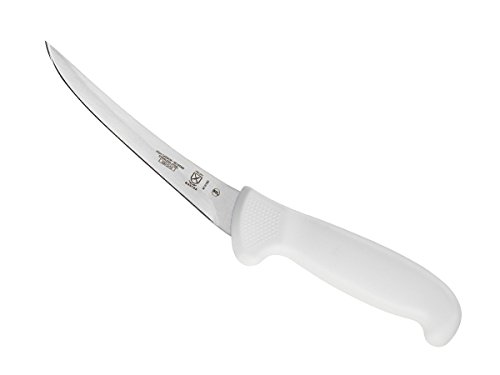 Mercer Ultimate White Curved | Camp kitchen pickHigh-carbon steel and a textured grip for very little money | ★★★★☆ 4/5 | Check price |
 Cold Steel Commercial Flexible | Game and fishThin full-tang German 4116 blade at about 3.7 ounces | ★★★★☆ 4/5 | Check price |
 Outdoor Edge RazorMax | Replaceable bladesDrop-point and 5-inch boning blades swap into one handle | ★★★★☆ 4/5 | Check price |
We ranked these from the makers’ specs and listings against the meat-table jobs in this guide; we did not process a deer with all seven for this update. The star ratings are our own editorial scores for how well each knife fits the job we give it.
How we picked
By the time a boning knife comes out, the hide is off, the quarters are on a clean surface and the heavy splitting is done by another tool. So we judged each knife on table work:
Then we gave every knife one job, so the best boning knives for deer processing here build a kit instead of seven duplicates.
1. Victorinox Fibrox Flexible Boning Knife: best overall
Victorinox Fibrox Flexible Boning Knife
A flexible 6-inch curved blade that follows every seam
A 6-inch curved flexible stainless boning knife with a textured, slip-resistant Fibrox handle, NSF certified and covered by a lifetime warranty against defects.
The Victorinox Fibrox Flexible Boning Knife is the safest default for most deer processors. Its 6-inch curved stainless blade has enough flex to follow the shape of a hindquarter without fighting the meat, and it’s long enough for roasts without getting clumsy on small trim.
The textured Fibrox handle stays grippy when it’s wet, it’s NSF certified, and Victorinox backs it with a lifetime warranty against defects. Pick it if you process one or several deer a season and want a dedicated table knife that feels natural quickly.
2. Victorinox Fibrox Semi-Stiff Boning Knife: best semi-stiff
Victorinox Fibrox Semi-Stiff Boning Knife
More backbone for joints, shanks and cold dense cuts
A 6-inch curved semi-stiff boning knife with the same non-slip Fibrox handle, made in Switzerland, that tracks straighter than a flexible blade on firm meat.
The Victorinox Fibrox Semi-Stiff Boning Knife is for hunters who like the Fibrox handle but want more authority at the edge. That extra backbone helps when meat is cold, when you’re working near joints, or when you want a knife that tracks straighter through dense cuts.
It gives up some fillet-like flex, so it’s less forgiving on paper-thin trimming. For many deer camps, though, it’s the best second knife after one flexible blade.
3. Dexter-Russell Basics Narrow Boning Knife: best value
Dexter-Russell Basics Narrow Boning Knife
A cheap, tough flexible blade for a dedicated game kit
A 6-inch narrow flexible boning knife with a stain-free high-carbon blade, hollow ground for easy re-sharpening, a slip-resistant polypropylene handle and NSF certification.
The Dexter-Russell Basics Narrow Boning Knife is the practical value pick. It isn’t fancy, but the narrow 6-inch flexible blade is hollow ground for quick re-sharpening, and the polypropylene handle can live in a processing box and get washed hard.
It’s made in the USA and NSF certified. It’s also a smart way to build redundancy: when two hunters are breaking down a deer, two clean boning knives matter more than one expensive showpiece.
4. Old Hickory Boning Knife: best carbon steel
Old Hickory Boning Knife
A thin, traditional carbon blade that takes a keen edge
The original Old Hickory carbon steel boning knife, a thin traditional blade for careful seam work on the meat table, for hunters willing to dry and oil it after cleanup.
The Old Hickory Boning Knife is the traditional choice. Its thin carbon steel blade appeals to hunters who enjoy keeping an edge and don’t mind a working patina. Around deer quarters, that thin profile is very effective when you handle it with patience.
The tradeoff is care. Wash it, dry it completely, and wipe on a little oil; never leave it in a damp sheath or sink. If camp cleanup is rushed, stainless is the lower-maintenance route.
5. Mercer Culinary Ultimate White Curved Boning Knife: best for the camp kitchen
Mercer Culinary Ultimate White Curved Boning Knife
A pro-kitchen curved boning blade at a camp-kit price
A 6-inch curved boning knife with a high-carbon Japanese steel blade and an ergonomic handle with textured finger points, made for separating meat from bone and trimming sinew.
The Mercer Culinary Ultimate White Curved Boning Knife gives deer processors a familiar pro-kitchen blade without making the kit expensive. Its high-carbon Japanese steel edge is easy to maintain, and the textured handle has finger points for a non-slip grip.
The white handle keeps it visually separate from your kitchen knives, so it’s easy to dedicate to wild game. It’s best at a table, tailgate or garage setup; Mercer says to wash it by hand.
6. Cold Steel Commercial Series Flexible Boning Knife: best for game and fish
Cold Steel Commercial Series Flexible Boning Knife
A thin, light flexible blade for deer, birds and fish
A 6-inch flexible full-tang boning knife in cryo-quenched German 4116 stainless, 1.75 mm thick, with a soft food-safe Kray-Ex handle and a lanyard hole, about 3.7 ounces.
The Cold Steel Commercial Series Flexible Boning Knife is a crossover blade for hunters who also clean fish, birds and small game. The 6-inch cryo-quenched German 4116 stainless blade is full tang and only 1.75 mm thick, and the whole knife weighs about 3.7 ounces.
Its soft Kray-Ex handle is food safe and has a lanyard hole. Use it as a meat-care knife, not a pry bar or a replacement for a stout fixed blade.
7. Outdoor Edge RazorMax: best replaceable-blade option
Outdoor Edge RazorMax
Swap between a drop-point and a boning blade in seconds
A replaceable-blade hunting knife with three 3.5-inch drop-point and three 5-inch boning/fillet blades, a rubberized non-slip handle and a nylon belt sheath.
The Outdoor Edge RazorMax is the outlier: it uses swappable blades instead of a fixed boning blade. The kit includes three 3.5-inch drop-point blades and three 5-inch boning/fillet blades, a rubberized non-slip handle and a nylon belt sheath.
It suits hunters who already like replaceable-blade systems and want a boning profile in the same handle they carry in the field. Keep spare blades organized, dispose of used ones safely, and still bring a clean table knife if you process several deer at once.
How to choose the best boning knives for deer processing
A deer-processing knife needs control more than brute strength. It earns its place by sliding along bone, separating natural seams, removing silver skin and cleaning trim for the grinder. Penn State Extension’s guide to processing wild game gives the same advice: separate whole muscles, keep the knife close to the bone and cut across the grain for roasts and steaks.
- Blade length: 5 to 6 inches is the sweet spot for whitetail quarters.
- Flex: flexible blades are better for trimming and seam work; semi-stiff blades feel steadier near joints.
- Handle: a grippy, easy-clean handle that still feels safe when your hands are cold or gloved.
- Steel: stainless is easier for wet cleanup; carbon steel takes a great edge but needs more care.
- Storage: a sheath, knife roll or dedicated drawer, so a thin edge doesn’t bang around in a tote.

Field dressing knife vs boning knife vs skinning knife
A field dressing knife opens the deer and handles rougher work around hide, hair and the body cavity. A skinning knife separates hide from meat with a belly or sweeping edge. A boning knife is the clean-table specialist: thinner, more precise and easier to steer along bone once the carcass is clean and stable.
Don’t ask one oversized hunting knife to do every job. A stout field knife may survive everything, but it usually wastes more meat during boning and tires your hand faster on several quarters. Our field dressing knife vs skinning knife guide covers the first two in more detail.
Blade length, flex and stiffness guide
Match the blade to the job you do most, then add a second knife for the other job:
| Blade type | Best at | Pick from this list |
|---|---|---|
| Flexible | Following seams, silver skin, clean roasts with light pressure | Victorinox flexible, Dexter-Russell, Cold Steel |
| Semi-stiff | Joints, shanks and cold, dense cuts | Victorinox semi-stiff, Mercer |
| Carbon steel | A keen working edge for patient seam work | Old Hickory |
| Replaceable blade | Field-to-table convenience with no sharpening | Outdoor Edge RazorMax |
Choose replaceable-blade only if you value convenience and already have a safe plan for spare and used blades.
Grip, safety, cleanup and edge maintenance
Boning knives are thin and sharp. A safe grip matters more than decorative handle material. Look for a handle that fills the hand, has texture and cleans without trapping fat. Wipe the handle before it gets slick and keep your off hand behind the edge path.
A cut-resistant glove on your holding hand adds a margin of safety on long sessions; the NoCry cut-resistant gloves are a food-safe, level 5 option to wear under a nitrile glove.
Touch up the edge before the season, after every long processing session, and any time the blade starts dragging through silver skin. Keep a sharpener near the table; start with our best hunting knife sharpeners, or learn how to sharpen a hunting knife in the field.
How to build a small deer-processing knife kit
You don’t need a butcher’s roll of knives. Build one of these three kits around the way you process:

For the field side, compare the best field dressing kits for deer and our best hunting knives. For hanging and skinning, a game hoist and gambrel makes the job far easier.
Buying mistakes to avoid
- Using a giant field knife for boning. Big blades are harder to steer and waste meat around seams.
- Skipping a flexible option. A stiff blade can work, but a flexible boning knife makes clean trim easier.
- Ignoring handle cleanup. Fat, blood and soap can turn a smooth handle slick.
- Forgetting storage. Thin boning edges get damaged quickly when loose in a tote.
- Buying a knife but no sharpening plan. A dull boning knife is slower and less safe.
Once the meat is boned out, the rest of the job is fast: cool the meat quickly, grind trim safely in one of the best meat grinders for deer, and package it with a vacuum sealer for venison. If you hunt in a CWD zone, read our CWD-safe deer processing guide before you cut.
Frequently asked questions
What size boning knife is best for deer processing?
A 6-inch boning knife is the best starting point for most deer hunters. It’s long enough for whitetail quarters but still easy to control when trimming roasts, silver skin and grinder meat. The Victorinox Fibrox Flexible Boning Knife is our default pick at that length.
Is a flexible or stiff boning knife better for deer?
Flexible is better for following seams and trimming. Semi-stiff is better for control around joints or cold, dense meat. Many hunters end up keeping one of each, such as the Victorinox flexible and the Victorinox Fibrox Semi-Stiff Boning Knife.
Can I use a fillet knife as a deer boning knife?
A fillet-style knife can work for light trimming if it has enough control and a safe handle. Very whippy fishing knives can feel too flexible on larger deer quarters, so pick a boning knife with moderate flex for most of the work.
Do I need a boning knife if I already have a hunting knife?
Yes, if you process your own deer. A hunting knife can field dress and skin, but a boning knife is cleaner and more efficient once the meat is on the table, and it wastes less venison around seams.
How should I clean a deer processing boning knife?
Wash it in hot, soapy water, rinse and dry it fully, touch up the edge if needed, and store it where the blade can’t hit other tools. Carbon steel knives like the Old Hickory Boning Knife need extra drying and a light coat of oil.